The Netherlands is widely known for having one of the tallest populations in the world. Dutch men and women often appear near the top of global height comparisons, making the country an interesting example for anyone studying human growth, population statistics, and lifestyle patterns.
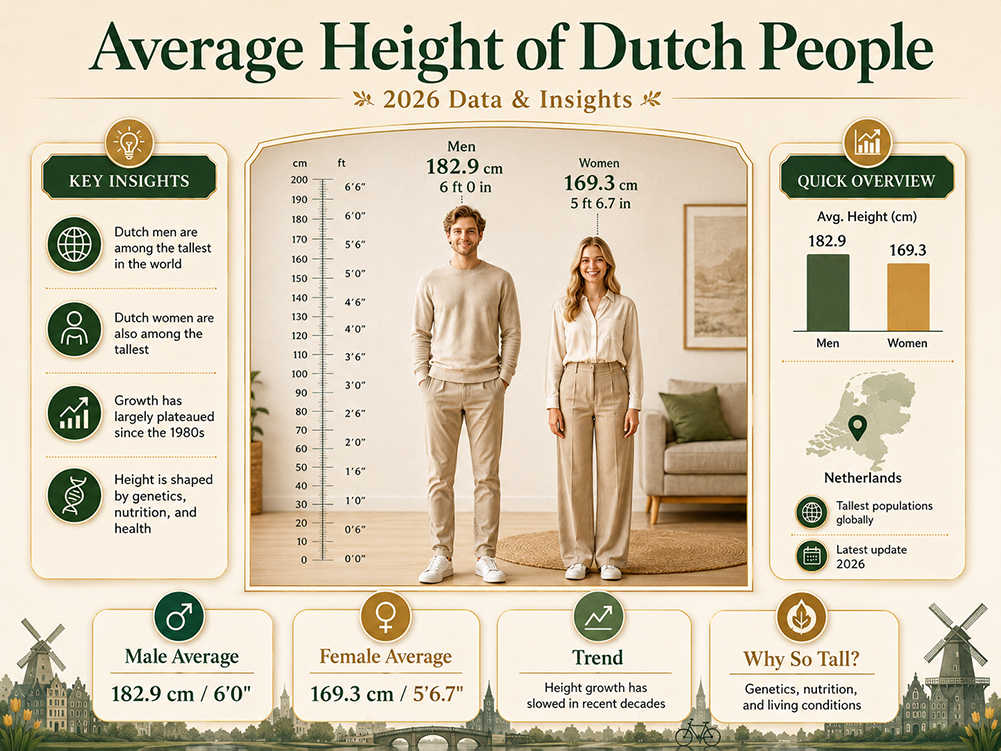
In 2026, the estimated average height of Dutch adults is:
- Men: 182.9 cm / 6'0"
- Women: 169.3 cm / 5'6.7"
These numbers represent population-level averages. They are useful for education and comparison, but they should not be used to evaluate an individual person's health, development, or growth pattern. Height can vary widely from person to person, even within the same country.
Why Are Dutch People So Tall on Average?
There is no single reason why Dutch people are tall on average. Height is influenced by a combination of biological, environmental, and lifestyle factors.
Common factors associated with height variation may include:
- Genetics
- Nutrition during childhood and adolescence
- Healthcare access
- Physical activity
- Sleep quality
- Living conditions
- Public health environment
Genetics plays a major role in adult height. However, environmental factors during childhood and adolescence may also be associated with long-term growth outcomes.
Over generations, changes in diet quality, healthcare, public health, and living standards have been linked to changes in average height across many populations.
What Makes the Netherlands Interesting in Height Research?
The Dutch population is often discussed because of its consistently high average height compared with many other countries. This makes the Netherlands a useful example when looking at how biology, lifestyle, and environment may interact over time.
At the same time, Dutch height trends have shown signs of slowing or plateauing in recent decades. This is a reminder that average height does not continue rising forever. Population trends can shift based on social, environmental, nutritional, and biological factors.
What Can We Learn From Dutch Height Trends?
The Dutch example shows that height is more than a simple measurement. At the population level, it can reflect long-term patterns in genetics, nutrition, healthcare, lifestyle, and living conditions.
However, average height data should always be interpreted carefully.
A population average is not a personal growth prediction. It cannot tell us whether one individual is healthy, whether someone will grow taller, or what a person's final height should be.
Instead, it is best understood as a broad educational tool for looking at trends across countries, generations, and communities.
A Balanced View of Height
Height is often discussed in comparison-based ways, especially online. But a healthier approach is to view height data as information, not judgment.
People grow differently. Adult height is influenced by many factors, and there is no single ideal height that applies to everyone.
This visual guide was created as an educational resource for readers interested in height data, population statistics, and international growth trends.
Educational Note
This content is for general informational and educational purposes only. It is not medical advice and does not provide diagnosis, treatment, prevention, or individual growth predictions. For personal health or growth-related concerns, consult a qualified healthcare professional.
FAQs
What is the average height of Dutch men?
The estimated average height of Dutch men in 2026 is about 182.9 cm, or approximately 6'0".
What is the average height of Dutch women?
The estimated average height of Dutch women in 2026 is about 169.3 cm, or approximately 5'6.7".
Are Dutch people the tallest in the world?
Dutch people are often ranked among the tallest populations globally, especially Dutch men. Rankings may vary depending on the data source, age group, and measurement method.
Is height only determined by genetics?
No. Genetics plays a major role, but nutrition, sleep, healthcare access, physical activity, and living conditions may also be associated with population-level height trends.
Can average height data predict individual growth?
No. Average height data can help explain population trends, but it cannot predict an individual person's final height, health status, or growth outcome.
References
NCD Risk Factor Collaboration. Human height data and global population trends.
World Health Organization. Child growth and development resources.
National Institutes of Health. Nutrition and human growth research.
Doctor Taller. Average Height of Dutch People. https://doctortaller.com/blogs/science-insight/average-height-of-dutch-people