How tall is the average woman in the United States?
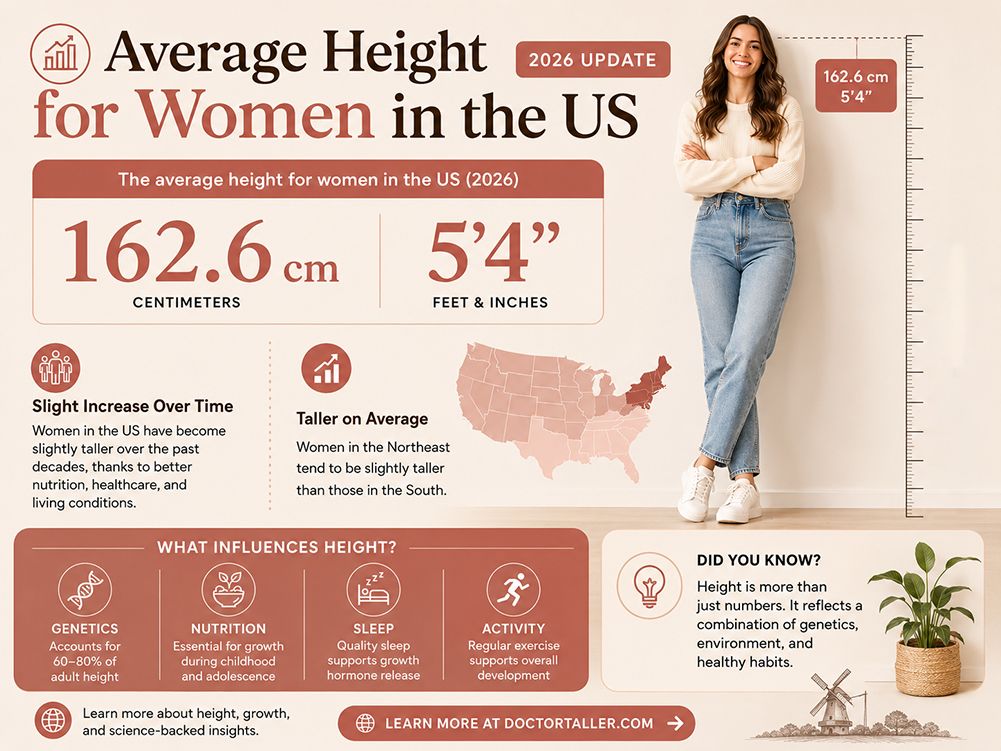
In 2026, the estimated average height for women in the US is about:
Women in the US: 162.6 cm / 5'4"
This number represents a general population average. It does not define what is normal, healthy, or ideal for every individual.
Some women are naturally shorter than average. Others are taller. Both can be completely normal.
Height is only one physical measurement, and it should never be used on its own to judge a person's health, confidence, appearance, or potential.
What Does Average Height Really Mean?
Average height is a population-level measurement. It helps researchers and readers understand general patterns across groups, countries, and generations.
But it does not tell the full story of any one person.
A person's height can vary based on many factors, including genetics, family background, nutrition, health history, environment, and development timing.
That is why average height data should be used for general education, not personal comparison.
What Factors May Influence Height?
Height is influenced by a combination of biological and environmental factors.
Genetics plays the largest role in adult height. However, other factors during childhood and adolescence may also be associated with healthy development.
Common factors linked to height variation may include:
- Genetics
- Nutrition during childhood and adolescence
- Sleep quality
- Physical activity
- Healthcare access
- Overall environment
- Living conditions
- Family background
At the population level, average height may reflect broader patterns in nutrition, healthcare, public health, and living conditions over time.
Why Average Height Data Matters
Average height data can help us better understand human development across communities and generations.
Researchers may use height trends to study how nutrition, healthcare access, living conditions, and public health relate to population-level growth patterns.
However, this data should always be interpreted with context.
Average height does not determine whether someone is healthy. It also does not define beauty, confidence, strength, or personal potential.
A Healthy Perspective on Height
For parents and families, average height data can be useful as a general reference. However, children and teens grow at different speeds.
Growth patterns may be affected by puberty timing, family history, nutrition, sleep, and overall health. Some children grow earlier, while others develop later.
The key takeaway is simple: healthy development is not about chasing one specific number. It is about supporting the body with balanced nutrition, quality sleep, regular movement, and healthy daily habits during the growing years.
This visual guide was created to help readers better understand average height data for women in the United States and the broader factors that may be associated with height variation.
FAQs
What is the average height for women in the US?
The estimated average height for women in the US in 2026 is about 162.6 cm, or approximately 5'4".
Is 5'4" considered normal for women in the US?
Around 5'4" is commonly cited as an average height for adult women in the United States. However, many healthy women are shorter or taller than this average.
What affects a woman's final height?
Final height is mostly influenced by genetics. Other factors, such as nutrition, sleep, healthcare access, overall health, and living conditions during childhood and adolescence, may also play a role.
Can average height data tell if someone is healthy?
No. Average height data cannot determine whether an individual is healthy. Height is only one measurement and should be considered alongside many other factors.
Should parents worry if their daughter is shorter than average?
Not always. Many children grow at different speeds. However, if growth suddenly slows, stops, or seems significantly delayed, parents should consider speaking with a qualified healthcare professional.
Educational Note
This content is for general informational and educational purposes only. It is not medical advice and does not provide diagnosis, treatment, prevention, or individual growth predictions. For personal health or growth-related concerns, consult a qualified healthcare professional.
References
Centers for Disease Control and Prevention. Growth charts and anthropometric reference data.
National Center for Health Statistics. Body measurements and population health data.
World Health Organization. Growth and development resources.
Doctor Taller. Average Height for Women in the US. https://doctortaller.com/blogs/science-insight/average-height-for-women-in-the-usa